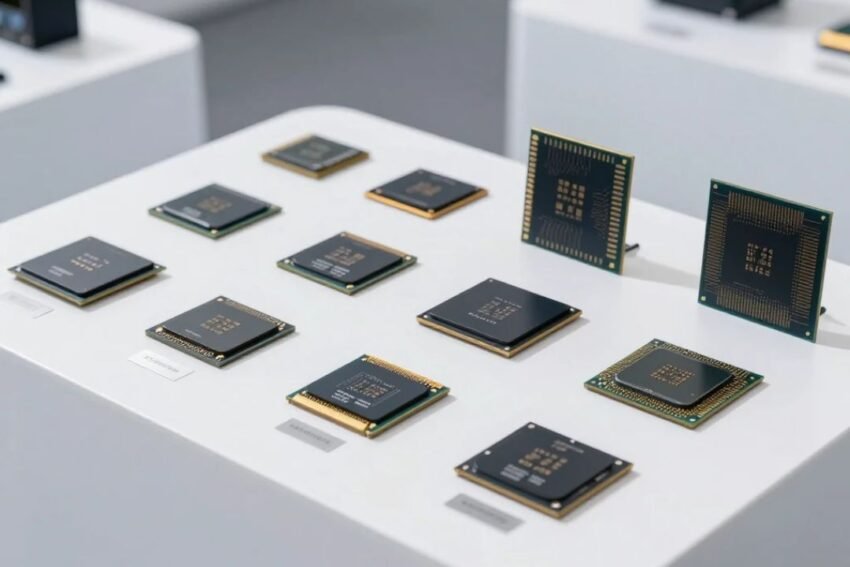
Introduction
Semiconductor technology is at the center of modern computing. Smartphones, laptops, cloud servers, electric vehicles, gaming systems, industrial machines, medical devices, and artificial intelligence systems all depend on advanced chips.
The rapid growth of artificial intelligence is creating new demand for powerful and efficient computing hardware. AI models require substantial processing power, memory bandwidth, networking capacity, and energy. As a result, semiconductor companies are developing specialized processors and new chip architectures designed specifically for AI workloads.
The top semiconductor and AI chip trends in 2026 include advanced manufacturing processes, specialized AI accelerators, chiplet architectures, advanced packaging, edge AI, AI PCs, high-bandwidth memory, energy-efficient computing, and increasingly sophisticated data-center infrastructure.
These developments are changing both the semiconductor industry and the broader technology market.
1. AI Accelerators Are Becoming More Important
One of the biggest AI chip trends in 2026 is the growing use of specialized AI accelerators.
Traditional CPUs remain essential for general-purpose computing, but AI workloads often involve large numbers of parallel mathematical operations.
AI accelerators are designed to handle workloads such as:
- Machine learning
- Deep learning
- Neural networks
- Generative AI
- Computer vision
- Natural-language processing
Specialized hardware can improve performance for suitable workloads while potentially reducing energy consumption.
2. Data Center AI Chips Continue to Evolve
The expansion of cloud AI services is increasing demand for powerful data-center hardware.
Large AI systems require more than just processors. They also depend on:
- High-bandwidth memory
- High-speed networking
- Storage
- Advanced packaging
- Power management
- Cooling infrastructure
Modern AI data centers increasingly function as complete computing systems rather than simple collections of servers.
As AI models become more computationally demanding, semiconductor manufacturers are focusing on improving performance across the entire infrastructure.
3. High-Bandwidth Memory Is Increasingly Important
Memory performance is a major factor in modern AI computing.
Large AI models frequently need to move enormous amounts of data between processing units and memory.
High-Bandwidth Memory, commonly known as HBM, is designed to provide high data-transfer rates in suitable high-performance computing systems.
HBM can help AI accelerators access large quantities of data efficiently.
As AI workloads expand, memory bandwidth is becoming nearly as important as raw processor performance for certain applications.
4. Chiplet Architecture Is Growing
Traditional processors often integrate many components onto a single large piece of silicon.
Chiplet architecture takes a different approach by dividing a complex processor into multiple smaller components.
These chiplets can be combined within a package.
Potential advantages include:
- Flexible designs
- Improved manufacturing efficiency
- Modular development
- Easier customization
- High performance
Chiplets can allow semiconductor companies to combine different technologies within a single computing package.
This approach is becoming increasingly relevant for high-performance computing and AI systems.
5. Advanced Chip Packaging
Semiconductor innovation is no longer focused only on making smaller transistors.
Advanced packaging is becoming a major area of development.
Packaging technologies can improve how different chip components communicate with each other.
Advanced packaging can help address:
- Data movement
- Memory bandwidth
- Energy efficiency
- Processor integration
- System performance
For AI workloads, reducing the distance between processing components and memory can be particularly important.
6. Smaller Semiconductor Process Technologies
Semiconductor manufacturers continue to develop increasingly advanced manufacturing processes.
Smaller process technologies can allow more transistors to be placed within a given area.
Potential benefits include:
- Higher performance
- Better energy efficiency
- Greater transistor density
- Smaller chips
However, moving to more advanced manufacturing technologies also creates significant engineering and manufacturing challenges.
As transistor structures become more sophisticated, semiconductor production requires increasingly advanced equipment and processes.
7. AI PCs Are Expanding
Artificial intelligence is moving from cloud data centers into consumer devices.
Modern PCs can include dedicated AI processing hardware such as neural processing units.
These AI-enabled computers can support tasks including:
- Video effects
- Voice processing
- Image enhancement
- Local AI assistants
- Generative AI applications
- Productivity features
Local AI processing can reduce the need to send every task to a remote cloud service.
This can also help reduce latency for supported applications.
8. AI Smartphones and On-Device Processing
Smartphones are also becoming increasingly capable AI devices.
Dedicated AI hardware can support:
- Camera processing
- Speech recognition
- Translation
- Image generation
- Photo editing
- Personalization
- Voice assistants
On-device AI can process some workloads locally.
This can provide benefits such as lower latency and reduced dependence on continuous cloud connectivity.
It can also provide additional privacy opportunities when sensitive processing remains on the device.
9. Edge AI Is Growing
Edge AI involves running artificial intelligence closer to where data is generated.
Instead of sending all information to a central cloud system, edge devices can process some data locally.
Potential edge AI devices include:
- Security cameras
- Industrial sensors
- Vehicles
- Robots
- Drones
- Wearables
- Smartphones
Edge AI can be particularly useful for applications that require rapid responses.
For example, an industrial machine may need to identify an operational problem immediately rather than waiting for information to travel to a remote data center.
10. Energy-Efficient AI Hardware
Energy efficiency is becoming an increasingly important semiconductor trend.
AI workloads can require significant computing resources, especially when running large models at scale.
Chip designers are therefore focusing on improving:
Performance per watt
Rather than measuring performance alone, organizations increasingly need to consider how much energy is required to achieve that performance.
Energy-efficient architectures can help reduce operating costs and support AI deployment in smaller devices.
11. Custom AI Chips
Large technology companies are increasingly interested in specialized hardware designed for their specific workloads.
Custom AI chips can be optimized for:
- Machine learning
- Cloud services
- Search
- Recommendation systems
- Generative AI
- Internal applications
Custom hardware can provide greater control over performance and efficiency.
However, designing custom chips requires substantial engineering resources and investment.
12. AI Networking Chips
As AI systems become larger, communication between processors becomes increasingly important.
Large AI clusters may contain many computing accelerators that need to exchange data rapidly.
High-speed networking technologies and specialized networking hardware can help connect these processors.
AI infrastructure therefore increasingly depends on:
- Network processors
- High-speed interconnects
- Data-center switches
- Optical communication
- Specialized networking technologies
Computing performance can be limited if processors cannot exchange information quickly enough.
13. Specialized Hardware for Generative AI
Generative AI applications create significant demand for specialized computing.
Large language models, image-generation systems, video models, and multimodal AI can require substantial computational resources.
AI chips are increasingly being optimized for workloads involving:
- Matrix multiplication
- Tensor operations
- Neural-network inference
- Large model serving
As generative AI expands, hardware efficiency will remain an important competitive factor.
14. AI Inference Hardware
AI inference is becoming an increasingly important hardware market.
Training a model and using a trained model are different workloads.
Training can require very large computing clusters, while inference may occur across cloud servers, PCs, smartphones, vehicles, and edge devices.
Inference hardware can be optimized for:
- Low latency
- Low energy consumption
- High throughput
- Local processing
This is particularly important as AI applications become part of everyday software and devices.
15. Semiconductor Technology for Autonomous Vehicles
The automotive industry is becoming another major consumer of advanced chips.
Modern vehicles can use processors for:
- Driver assistance
- Computer vision
- Sensor processing
- Navigation
- Infotainment
- Battery management
- Vehicle control
Advanced driver-assistance systems can require substantial processing power to analyze information from cameras, radar, lidar, and other sensors.
Future vehicles are therefore likely to depend on increasingly sophisticated semiconductor systems.
16. AI Chips for Robotics
Robots need computing systems capable of processing information from their environment.
AI hardware can support:
- Computer vision
- Object recognition
- Navigation
- Motion planning
- Speech interaction
- Sensor fusion
As robotics becomes more autonomous, specialized AI processors may become increasingly important.
Industrial robots, service robots, drones, and humanoid systems can all benefit from efficient AI computing.
17. Semiconductor Security
As chips become more powerful and connected, hardware security is becoming increasingly important.
Modern semiconductor security can involve:
- Secure boot
- Hardware encryption
- Trusted execution
- Authentication
- Secure key storage
- Firmware protection
Security features can help protect devices from unauthorized access and certain forms of hardware-based attacks.
This is especially important for connected devices, vehicles, cloud infrastructure, and enterprise systems.
18. AI Chip Software Ecosystems
Hardware performance depends heavily on software.
Developers need compilers, libraries, frameworks, drivers, and development tools that can take advantage of specialized hardware.
A strong AI chip ecosystem can include:
- Machine learning frameworks
- Optimized libraries
- Compilers
- APIs
- Development environments
- Model optimization tools
Therefore, AI chip competition is not simply about physical hardware.
Software compatibility and developer support can also influence how easily a chip can be used.
19. Semiconductor Supply Chain Innovation
The semiconductor supply chain is highly complex.
It can involve:
- Chip designers
- Semiconductor manufacturers
- Equipment suppliers
- Packaging companies
- Testing providers
- Memory manufacturers
- Networking companies
Advanced AI hardware increases demand for many parts of this ecosystem.
Companies are therefore investing in manufacturing capacity, packaging technologies, supply-chain resilience, and specialized infrastructure.
20. Semiconductor Sustainability
Sustainability is becoming increasingly relevant to semiconductor manufacturing and AI infrastructure.
Chip manufacturing can require significant amounts of energy, water, and specialized materials.
AI data centers also consume substantial energy because they operate large computing systems and cooling infrastructure.
Future semiconductor development will increasingly focus on:
- Energy-efficient chips
- Better cooling
- Efficient manufacturing
- Resource management
- Lower-power AI processing
Improving performance while reducing energy requirements is becoming a major engineering objective.
Benefits of Modern Semiconductor & AI Chip Innovation
The latest semiconductor trends can provide several benefits.
Faster AI
Specialized processors can accelerate suitable AI workloads.
Better Energy Efficiency
Optimized architectures can improve performance per watt.
Local AI Processing
Edge hardware allows some AI workloads to run directly on devices.
Smaller Devices
Advanced semiconductor technology allows greater computing capability in compact products.
Better Automation
AI chips can support robotics, vehicles, industrial systems, and intelligent software.
Scalable AI Infrastructure
Advanced processors, memory, networking, and packaging can support large AI systems.
Challenges Facing AI Chip Development
Despite rapid innovation, the industry faces significant challenges.
Manufacturing Complexity
Advanced chips require highly sophisticated manufacturing processes.
High Development Costs
Designing and producing cutting-edge processors can require substantial investment.
Energy Consumption
Large AI systems can require significant amounts of electricity.
Heat Management
High-performance processors generate heat that must be removed efficiently.
Software Compatibility
Hardware needs suitable software ecosystems to achieve its potential.
Supply Chain Complexity
Advanced chips depend on highly interconnected global supply chains.
How AI Chips Could Change Computing
AI chips are changing the traditional relationship between software and hardware.
In the past, many applications relied primarily on general-purpose CPUs.
Modern computing increasingly combines:
- CPUs
- GPUs
- NPUs
- AI accelerators
- Specialized processors
- High-bandwidth memory
This heterogeneous computing model allows different processors to handle different workloads.
The result can be a more efficient computing system where each component is optimized for a particular task.
Future of Semiconductor & AI Chip Technology
The semiconductor industry is likely to continue developing more specialized and efficient computing architectures.
Future developments may include:
- More advanced AI accelerators
- Smaller and more efficient processors
- Advanced chiplets
- Improved packaging
- Faster memory
- Better AI networking
- More capable edge processors
- Specialized inference hardware
- Energy-efficient architectures
- Greater integration between AI hardware and software
The industry will increasingly focus on complete computing systems rather than isolated chips.
Conclusion
The top semiconductor and AI chip trends in 2026 reflect the growing importance of artificial intelligence and advanced computing.
AI accelerators, high-bandwidth memory, chiplet architectures, advanced packaging, AI PCs, smartphones, edge computing, custom processors, and specialized inference hardware are transforming the semiconductor landscape.
At the same time, AI infrastructure increasingly depends on networking, security, cooling, software ecosystems, and efficient data-center design.
The future of semiconductor technology will not be determined by processor speed alone. Performance per watt, memory bandwidth, software compatibility, security, manufacturing efficiency, and system-level integration will all play important roles.
As artificial intelligence becomes more deeply integrated into software, devices, vehicles, robotics, and business systems, demand for specialized computing hardware is likely to remain strong.
Semiconductors are the foundation of modern computing, while AI chips are becoming the foundation of the next generation of artificial intelligence. Continued innovation in both areas will help shape the future of computing, automation, and digital technology.