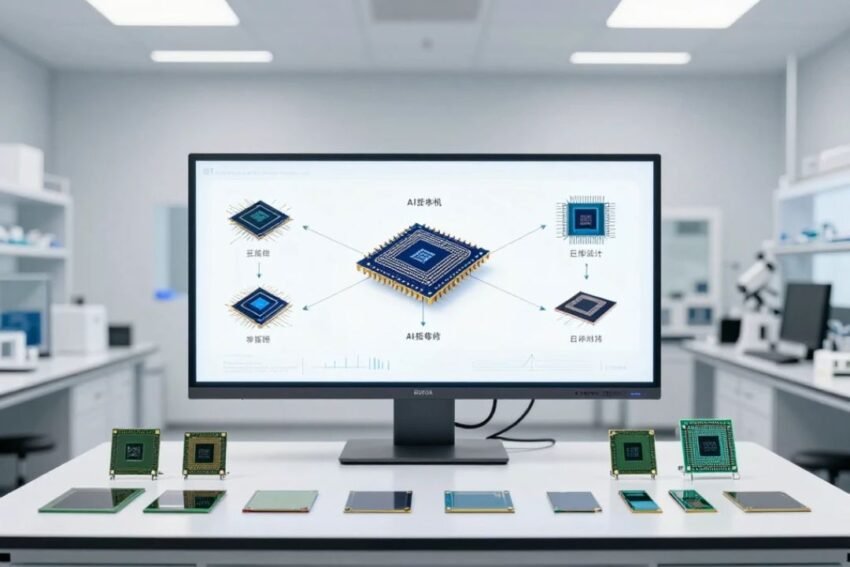
Introduction
Semiconductors are among the most important technologies behind the modern digital world. Almost every electronic device depends on semiconductor components, including smartphones, computers, vehicles, servers, medical equipment, industrial machines, and smart home devices.
The rapid development of artificial intelligence has made semiconductors even more important. AI applications require powerful computing hardware to train and run increasingly sophisticated models. As a result, specialized AI chips are becoming a major part of the semiconductor industry.
Unlike traditional processors designed for a wide range of computing tasks, AI chips are often optimized for workloads such as machine learning, neural networks, image processing, and large-scale data operations.
Understanding Semiconductors & AI Chips is therefore important for anyone interested in artificial intelligence, cloud computing, smartphones, gaming, robotics, electric vehicles, and next-generation technology.
This guide explains what semiconductors and AI chips are, how they work, their major types, applications, benefits, challenges, and future trends.
What Is a Semiconductor?
A semiconductor is a material whose electrical conductivity falls between that of a conductor and an insulator.
Semiconductors can be engineered to control the flow of electrical current, making them extremely useful for building electronic components.
The most widely used semiconductor material is silicon.
Semiconductors are used to create components such as:
- Transistors
- Diodes
- Integrated circuits
- Memory chips
- Microprocessors
- Sensors
- Power-management components
These components form the foundation of modern electronics.
What Is a Computer Chip?
A computer chip, also known as an integrated circuit, contains electronic components manufactured together on a small piece of semiconductor material.
A modern chip can contain millions or even billions of transistors.
These transistors can perform logical operations and control electrical signals.
Computer chips are used in:
- Smartphones
- Laptops
- Desktop computers
- Servers
- Cars
- Gaming consoles
- Smart appliances
- Industrial equipment
The increasing number and sophistication of transistors have allowed computing devices to become more powerful and energy efficient.
What Are AI Chips?
AI chips are processors or specialized computing components designed or optimized for artificial intelligence workloads.
AI applications often perform enormous numbers of mathematical operations involving matrices, vectors, and neural networks.
AI chips can accelerate these workloads by providing specialized computing architectures.
They can be used for:
- Machine learning
- Deep learning
- Generative AI
- Computer vision
- Natural-language processing
- Robotics
- Autonomous systems
- Recommendation systems
AI chips can exist in data centers, personal computers, smartphones, vehicles, robots, and edge devices.
How Do AI Chips Work?
AI models require large numbers of mathematical calculations.
Traditional CPUs can perform these calculations, but they are not always optimized for the highly parallel workloads common in modern AI.
AI accelerators are designed to perform many operations simultaneously.
Depending on the architecture, an AI chip may include specialized processing units for:
- Matrix calculations
- Tensor operations
- Vector processing
- Neural-network inference
- Data movement
This specialization can improve performance for particular AI workloads.
Main Types of Semiconductor Chips
The semiconductor industry includes many different types of chips.
CPUs
Central Processing Units, or CPUs, are general-purpose processors.
They are designed to handle many different types of computing tasks.
CPUs are commonly found in:
- Computers
- Servers
- Smartphones
- Embedded systems
- Vehicles
They remain essential even when specialized AI accelerators are available.
GPUs
Graphics Processing Units, or GPUs, were originally developed primarily for graphics processing.
However, their highly parallel architecture also makes them useful for artificial intelligence and machine learning.
Modern GPUs are widely used for:
- AI training
- AI inference
- Scientific computing
- Gaming
- Graphics rendering
- High-performance computing
NPUs
Neural Processing Units, or NPUs, are specialized processors designed for AI-related workloads.
NPUs are increasingly being integrated into smartphones, laptops, and other consumer devices.
They can help run AI tasks locally instead of sending every operation to a cloud server.
Potential applications include:
- Image enhancement
- Speech recognition
- Translation
- Generative AI features
- Camera processing
- Personal assistants
TPUs
Tensor Processing Units, or TPUs, are specialized AI processors designed for tensor and machine learning workloads.
They are particularly associated with large-scale AI computing environments.
Specialized tensor-processing architectures can accelerate certain machine learning operations compared with general-purpose processors.
ASICs
Application-Specific Integrated Circuits, or ASICs, are chips designed for particular applications.
Because they are highly specialized, they can provide strong performance and efficiency for their intended workloads.
However, ASICs are less flexible than general-purpose processors.
FPGAs
Field-Programmable Gate Arrays, or FPGAs, can be configured after manufacturing for specific workloads.
They provide a balance between flexibility and hardware acceleration.
FPGAs can be useful for:
- Networking
- Industrial systems
- Data centers
- Signal processing
- Specialized AI workloads
AI Training vs AI Inference Chips
AI workloads can generally be divided into two major categories: training and inference.
AI Training
Training involves teaching a model using large quantities of data.
Training workloads can require significant computing power.
They often run in data centers using large clusters of accelerators.
AI Inference
Inference occurs when a trained AI model is used to generate predictions or responses.
For example, when an AI assistant answers a question, the underlying model is performing inference.
Inference can happen in:
- Cloud data centers
- Smartphones
- PCs
- Vehicles
- Robots
- Edge devices
Different hardware designs may be optimized for different training and inference requirements.
Why AI Chips Are Important
The growth of AI is increasing demand for specialized computing hardware.
Modern AI models can contain extremely large numbers of parameters and require substantial computing resources.
AI chips can help address several requirements.
Higher Performance
Specialized hardware can accelerate specific AI operations.
Better Energy Efficiency
Hardware optimized for AI workloads can perform certain calculations more efficiently.
Lower Latency
Local AI processing can reduce the time required to send information to and from a cloud server.
Larger AI Workloads
Data centers can combine large numbers of accelerators to support demanding AI applications.
Applications of AI Chips
AI chips are being used across many industries.
Smartphones
Modern smartphones increasingly include specialized AI processors.
AI hardware can support:
- Camera enhancements
- Face recognition
- Voice processing
- Translation
- Generative AI
- Image editing
Local processing can also reduce the need to send some information to remote servers.
Data Centers
Large data centers use powerful processors and accelerators to support AI services.
Applications include:
- Generative AI
- Search
- Recommendation systems
- Cloud AI services
- Machine learning
- Scientific computing
Data center AI infrastructure is becoming increasingly important as AI applications expand.
Autonomous Vehicles
Vehicles can use AI processors to analyze information from cameras, radar, lidar, and other sensors.
Potential applications include:
- Object detection
- Driver assistance
- Navigation
- Sensor processing
- Decision support
Automotive AI hardware must meet demanding requirements for performance, reliability, and energy efficiency.
Robotics
Robots can use AI chips to process sensor information and make decisions.
AI hardware can support:
- Computer vision
- Navigation
- Object recognition
- Motion planning
- Speech interaction
As robots become more intelligent, specialized computing hardware can become increasingly important.
Healthcare
AI chips can support medical applications involving image analysis, research, and data processing.
Potential applications include:
- Medical imaging
- Research
- Diagnostic assistance
- Signal processing
- Drug discovery
Healthcare applications require careful validation and appropriate oversight.
Semiconductor Manufacturing
Producing advanced semiconductor chips is a complex process.
It involves several stages, including:
- Chip architecture and design
- Circuit design
- Wafer manufacturing
- Lithography
- Etching and deposition
- Packaging
- Testing
Advanced semiconductor manufacturing requires highly specialized equipment and facilities.
Modern chip production can involve extremely small manufacturing features, allowing more transistors to fit onto a chip.
Advanced Chip Packaging
Chip packaging has become increasingly important as semiconductor designs become more complex.
Traditional approaches often place a complete chip design within a single package.
Modern approaches can combine multiple chip components using advanced packaging technologies.
These approaches can improve:
- Performance
- Energy efficiency
- Data movement
- Manufacturing flexibility
Chiplet-based designs are one example of how the semiconductor industry is exploring more modular architectures.
Semiconductors and AI Infrastructure
AI requires more than processors.
Modern AI infrastructure can include:
- AI accelerators
- CPUs
- High-speed memory
- Networking chips
- Storage
- Power-management components
- Advanced packaging
- Cooling systems
Large AI systems therefore depend on an entire hardware ecosystem.
The performance of an AI system can be limited not only by computing power but also by memory bandwidth, networking, storage, and energy availability.
AI Chips and Edge Computing
Not every AI application needs to run in a large cloud data center.
Edge AI allows machine learning models to operate closer to where data is generated.
Examples include:
- Smart cameras
- Industrial sensors
- Wearables
- Smartphones
- Vehicles
- Drones
- Robots
Edge AI can reduce latency and potentially improve privacy because some information can be processed locally.
Benefits of Semiconductor and AI Chip Innovation
Continued semiconductor development can provide several benefits.
Faster Computing
More advanced architectures can improve processing performance.
Energy Efficiency
Specialized hardware can improve performance per unit of energy for suitable workloads.
Smaller Devices
Advanced semiconductor manufacturing allows powerful computing capabilities to fit into smaller devices.
AI Accessibility
Dedicated AI processors can bring machine learning capabilities to consumer devices.
Industrial Innovation
AI hardware can support robotics, automation, vehicles, healthcare, and other technologies.
Challenges Facing the Semiconductor Industry
The semiconductor industry also faces major challenges.
Manufacturing Complexity
Advanced chip manufacturing requires highly sophisticated equipment and facilities.
High Development Costs
Designing and producing advanced processors can require significant investment.
Supply Chain Complexity
Semiconductor production involves companies and suppliers across multiple regions.
Energy Requirements
Large semiconductor manufacturing facilities and AI data centers can require substantial amounts of energy.
Heat Management
High-performance processors generate heat that must be managed through advanced cooling systems.
Rapid Technology Development
Chip companies must continually improve architectures to keep pace with increasing computing requirements.
Future Trends in Semiconductors & AI Chips
The semiconductor industry is expected to continue evolving rapidly.
Smaller Process Technologies
Manufacturers continue developing increasingly advanced process technologies.
More Specialized AI Accelerators
AI workloads are likely to encourage the development of more specialized hardware.
Chiplet Architectures
Modular chip designs can provide new approaches to performance and manufacturing.
Advanced Packaging
Packaging technologies will become increasingly important for high-performance computing.
Edge AI
More devices will gain local AI processing capabilities.
AI PCs and Smartphones
Consumer devices are increasingly incorporating dedicated AI hardware.
Energy-Efficient Computing
Improving performance while controlling energy consumption will remain a major priority.
AI Data Center Hardware
Growing AI workloads will continue driving demand for advanced processors, memory, networking, and cooling technologies.
How to Choose an AI Chip
The right AI chip depends on the intended application.
Important factors include:
- AI workload
- Performance requirements
- Memory capacity
- Memory bandwidth
- Energy efficiency
- Software compatibility
- Cost
- Device size
- Cooling requirements
A chip designed for a smartphone has very different requirements from an accelerator used in a large AI data center.
Therefore, performance should always be considered in the context of the actual workload.
Conclusion
Semiconductors & AI Chips are fundamental technologies behind modern computing and the rapid development of artificial intelligence.
Semiconductors provide the foundation for electronic components, while CPUs, GPUs, NPUs, TPUs, ASICs, and FPGAs provide different approaches to processing information.
AI chips are becoming increasingly important because modern artificial intelligence requires substantial computing power. Specialized processors can accelerate machine learning workloads while potentially improving energy efficiency and reducing latency.
These technologies are being used in data centers, smartphones, PCs, vehicles, robotics, healthcare systems, industrial equipment, and edge devices.
The future of semiconductors will likely involve advanced manufacturing processes, specialized AI accelerators, chiplet architectures, advanced packaging, edge AI, and more energy-efficient computing.
As artificial intelligence continues to expand, the relationship between software and semiconductor hardware will become even more important.
The future of AI depends not only on better algorithms and larger models but also on better chips. Semiconductor innovation will remain one of the key foundations of next-generation computing and artificial intelligence.